
What Is AI (Artificial Intelligence)?
Artificial Intelligence (AI) is technology that enables computers to learn from data and make decisions, without being explicitly programmed for every single scenario.
Think of it this way: when you teach a child to recognize a dog, you show them hundreds of dogs, big dogs, small dogs, fluffy dogs. Eventually, the child learns to identify any dog they see. AI works similarly. It’s trained on massive amounts of data until it learns to recognize patterns, make predictions, and perform tasks that typically require human intelligence.
These tasks include:
- Learning: picking up information and improving over time
- Reasoning: drawing logical conclusions
- Problem-solving: finding answers to complex questions
- Understanding language: reading, writing, and speaking like a human
- Seeing and interpreting: recognizing images, faces, and environments
AI isn’t magic. It’s math, data, and a lot of computing power working together.
A Brief History: How Did AI Start?
AI isn’t new. The idea of “thinking machines” goes back to the 1950s, when mathematician Alan Turing asked the question: “Can machines think?”
Here’s a quick timeline of how AI evolved:
Today, AI is no longer a lab experiment. It powers your Netflix recommendations, your spam filter, your Google search, your phone’s face unlock, and much, much more.
How Does AI Actually Work?
At its core, AI works in a cycle:
- Data Collection: The system gathers large datasets (text, images, numbers, etc.)
- Training: Algorithms find patterns in that data
- Testing: The model is evaluated on unseen examples
- Deployment: It goes live in real-world applications
- Feedback & Improvement: It gets better over time with new data
The key technologies that power modern AI include:
- Machine Learning (ML): Systems that learn and improve from experience without explicit programming. Netflix’s recommendation engine is a classic example, it studies what you watch and suggests more of it.
- Deep Learning: A subset of ML that uses artificial neural networks, inspired by the human brain, to handle complex tasks like image recognition, language translation, and voice processing.
- Natural Language Processing (NLP): This allows machines to understand and generate human language. Every time you talk to a chatbot or use voice search, NLP is at work.
- Computer Vision: AI’s ability to interpret images and video. This powers facial recognition, medical imaging analysis, and self-driving car cameras.
The 3 Types of AI You Should Know
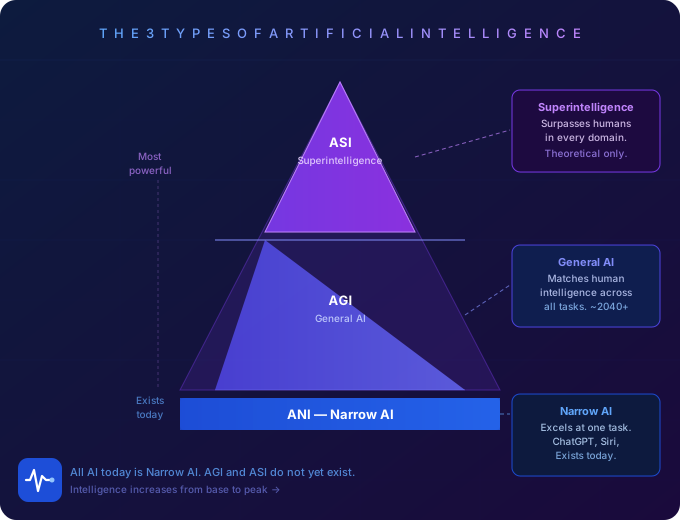
1. Narrow AI (ANI): What Exists Today
Narrow AI is designed to do one specific job very well. It cannot go beyond its programmed area.
Examples: ChatGPT (conversation), recommendation engines, spam filters, fraud detection systems.
Important: All AI in 2026 is Narrow AI. Every tool you use today, no matter how impressive — is still narrow AI.
2. General AI (AGI): The Theoretical Next Step
General AI would match human intelligence across all tasks — learning, reasoning, and adapting across any domain. It doesn’t exist yet. Most experts estimate it could emerge somewhere between 2040 and 2060, though timelines remain highly uncertain.
3. Superintelligence (ASI) — Still Science Fiction
Artificial Superintelligence would surpass human intellect in every possible way. It remains theoretical and exists only in research discussions and philosophical debates.
Where Is AI Being Used Right Now?
AI is already transforming virtually every industry:
- Healthcare: Analyzing X-rays and MRIs, assisting in drug discovery, predicting effective treatments for individuals.
- Finance: Detecting fraud in real-time, assessing risk, automating investment strategies.
- Education: Personalizing learning paths, automating grading, identifying learning gaps.
- Retail & E-commerce: Powering product recommendations, optimizing inventory, personalizing marketing.
- Manufacturing: Predictive maintenance, quality control, supply chain optimization.
The Stanford AI Index 2025 notes that AI is now deeply integrated into nearly every aspect of modern life, reshaping education, finance, healthcare, and beyond.
What Is Agentic AI? The Next Big Leap
Here’s where things get really interesting.
You’ve used ChatGPT. You’ve asked it a question and it gave you an answer. That’s reactive AI — it waits for you to prompt it, and then it responds.
Agentic AI is completely different.
Agentic AI is an autonomous AI system that can act independently to achieve goals — without constant human oversight or step-by-step instructions. The word “agentic” comes from “agency” — the ability to act on your own.
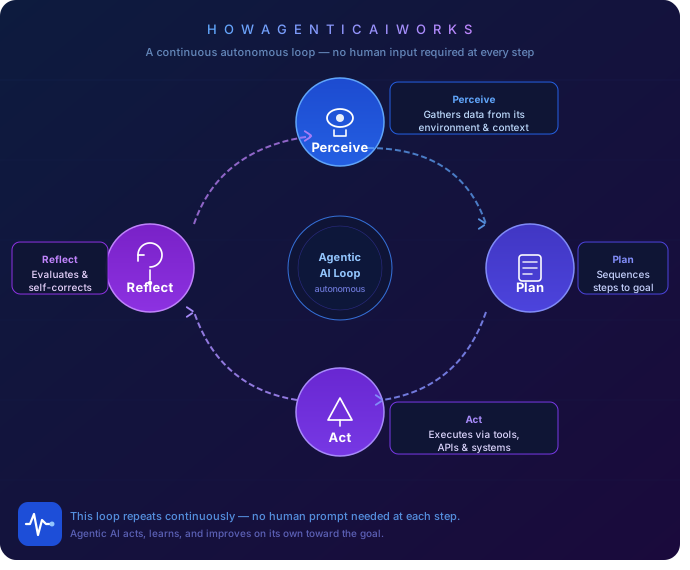
Instead of waiting for your next command, agentic AI:
- Perceives its environment and gathers context
- Plans a sequence of steps to accomplish a goal
- Acts by using tools, APIs, and other systems
- Reflects on results and self-corrects if something goes wrong
- Learns from each experience to improve over time
In simple terms: if regular AI is a calculator you operate, Agentic AI is a capable colleague who takes a task from you and handles it — start to finish — while you focus on other things.
A Real-World Example of Agentic AI
Here’s one of the clearest examples from MIT Sloan:
Imagine you ask an agentic AI to plan a vacation. Instead of just giving you a list of hotel suggestions, it accesses travel websites, checks your email preferences, reads your calendar, compares flight prices, and — with your credit card permission — books the entire trip autonomously. No follow-up prompts needed.
That’s the power of agentic AI. It executes multi-step plans, uses external tools, and interacts with digital environments to complete complex goals independently.
Another example: Customer Support
A customer reports a broken product. A traditional chatbot asks a few questions and escalates to a human. An agentic AI system, however:
- Reads the support ticket and classifies the issue
- Checks the warranty status in the CRM
- Searches the knowledge base for a troubleshooting guide
- Generates a personalized email with a return label
- Updates the case status to “Resolved”
- Notifies the warehouse — all without a human touching it
How Agentic AI Works: The 4-Step Loop
Agentic AI operates through a continuous cycle:
- 1. Perception The agent gathers information from its environment — text, voice, images, databases, APIs, and more. It doesn’t just process structured data like a spreadsheet; it understands unstructured, real-world inputs.
- 2. Reasoning & Planning Using a Large Language Model (LLM) as its “brain,” the agent breaks a complex goal into smaller sub-tasks, sequences them logically, and selects the best approach.
- 3. Action The agent executes tasks — updating records, sending emails, searching the web, calling APIs, generating content, or coordinating with other AI agents.4. Memory & Reflection The agent stores what it learned (short-term context, long-term outcomes), evaluates whether the result matched the goal, and adjusts its strategy if needed.
This loop repeats continuously, allowing agentic AI to navigate complex, real-world workflows without someone holding its hand at every step.
Agentic AI vs. Generative AI: What’s the Difference?
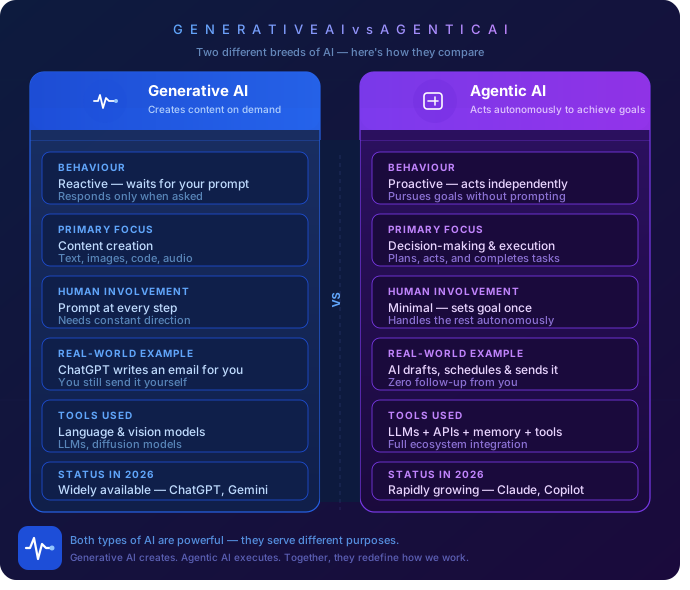
This is a question a lot of people get confused about. Here’s the clearest breakdown:
| Feature | Generative AI | Agentic AI |
|---|---|---|
| What it does | Creates content (text, images, code) | Takes autonomous action to achieve goals |
| How it works | Reactive — responds to your prompt | Proactive — acts without constant input |
| Human involvement | Needs prompts at every step | Minimal; works independently |
| Example | ChatGPT writing an email for you | An AI agent that drafts, schedules, and sends the email on its own |
| Focus | Content creation | Decision-making and execution |
Think of it this way: Generative AI is a brilliant writer. Agentic AI is a brilliant employee who can write, plan, coordinate, and execute — without being micromanaged.
Why Agentic AI Is a Massive Deal in 2026
The numbers tell the story:
- A 2026 MIT Sloan and BCG survey found that 35% of organizations had already adopted AI agents, with another 44% planning to deploy them soon.
- Gartner predicts that by 2028, one-third of all enterprise software will include agentic AI capabilities, automating up to 15% of everyday business tasks.
- Nvidia CEO Jensen Huang called enterprise AI agents a “multi-trillion-dollar opportunity” at CES 2025.
Major platforms — Microsoft, Salesforce, Google, IBM — are now embedding agentic AI directly into their software products. This isn’t a distant future. It’s happening right now.
The Risks and Challenges of Agentic AI
To give you a complete picture, it’s important to acknowledge the challenges too.
- Data Quality: Agentic systems are only as good as the data they operate on. Inconsistent or poor-quality data leads to poor decisions.
- Governance & Trust: When AI acts autonomously, who is responsible when something goes wrong? Establishing clear accountability is still a work in progress.
- Security: Autonomous agents that can access systems and APIs introduce new cybersecurity risks.
- Over-reliance: Some organizations are deploying agentic AI without fully understanding its capabilities or having a formal risk strategy — a dangerous gap.
- Human Oversight: The most successful agentic AI deployments maintain human-in-the-loop controls for high-stakes decisions, rather than giving the system complete unchecked autonomy.
Responsible deployment — with clear goals, feedback loops, and governance — is what separates organizations that benefit from agentic AI from those that create new problems with it.
Frequently Asked Questions (FAQs)
Q: What is AI in simple words? AI is technology that allows computers to learn from data and perform tasks that normally require human intelligence — like recognizing speech, translating languages, or making decisions.
Q: Is ChatGPT an example of AI? Yes. ChatGPT is an example of Generative AI — a type of narrow AI trained on massive text data to understand and generate human language.
Q: What makes Agentic AI different from regular AI? Regular AI (like a chatbot) waits for your prompt and responds. Agentic AI takes initiative — it receives a goal, plans the steps, uses available tools, and completes the task autonomously.
Q: Is Agentic AI available today? Yes. Early forms of agentic AI are already deployed in customer service, research, supply chain management, finance, and healthcare. Tools like Claude Code, AutoGPT, and enterprise platforms from Salesforce and Microsoft are examples.
Q: Is Agentic AI dangerous? Like any powerful technology, it carries risks — especially around security, governance, and unintended behaviors. These are real challenges that researchers and companies are actively working to address.
Q: Will AI replace human jobs? AI will automate many repetitive tasks, but it also creates new roles. The transition may be disruptive for some sectors, but humans remain essential for strategy, creativity, empathy, and oversight.
Key Takeaways
Let’s bring it all together:
- AI is technology that enables machines to learn, reason, and make decisions — mimicking human intelligence.
- All AI today is Narrow AI — highly capable within specific domains, but not broadly intelligent.
- Generative AI (like ChatGPT) creates content in response to your prompts.
- Agentic AI goes further — it acts autonomously, executes multi-step tasks, uses tools, and works toward goals with minimal human intervention.
- Agentic AI operates through a loop of Perception → Reasoning → Action → Reflection.
- The technology is already here, with major adoption happening across industries in 2026.
- Responsible use — with human oversight, clear governance, and data quality — is essential.
What Should You Do Next?
If you’re curious about AI, the best time to start learning is now. You don’t need to be a programmer or a data scientist. Start by:
- Experimenting with tools like Claude, ChatGPT, or Gemini to understand what generative AI can do
- Reading about how companies in your industry are using AI agents
- Following trusted sources like Stanford HAI, MIT Sloan, and IBM Think for developments in agentic AI
Understanding AI — and specifically Agentic AI — is quickly becoming as essential as digital literacy itself. The organizations and individuals who grasp it early will have a significant advantage.


